19 June 2026
Antigone in autumn
At line 943 of this play Antigone utters her final words as a living person and exits to her death. She has just sung her own funeral dirge, unusual girl that she is, and the dirge ends with her summary statement of what she did wrong, the reason why she is condemned to die. Her tone is raw, astounded and sad, yet also unshakeable. It makes no sense to her that things worked out the way they did, still she remains clear about the moral quotient of the situation. She expresses all this in a sentence that is almost a paradox:
I was caught in an act of perfect piety.
Surely piety is not a criminal act in which one is “caught”? Surely piety is a good thing? Surely the community that outlaws an act of perfect piety is a community that has tipped over the edge into nonsense? Antigone stands poised on this edge, holding onto sense.
Anne Carson, ‘A Note from the Translator’, Sophokles, Antigone, trans. by Anne Carson (London: Methuen, 2015) p. 5
I don’t agree that just because something is deemed incorrect by those in power at this point in history means that it is the wrong thing to do.
Lottie Head, Filton 24
I.
The film The Lost Honour of Katharina Blum, or: How violence develops and where it can lead, based on a 1974 novel by Heinrich Böll, was adapted and directed by Volker Schlöndorff and Margarethe von Trotta and released in West Germany in 1975.
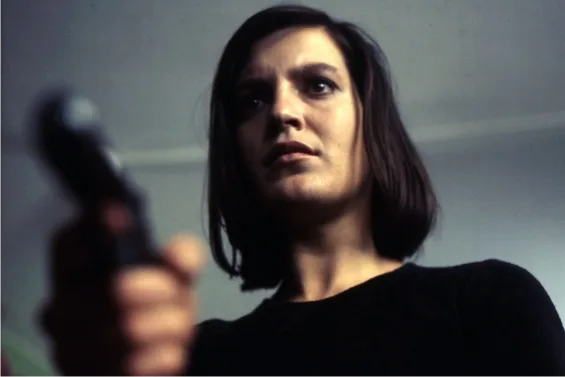
Angela Winkler plays the eponymous heroine. Katharina Blum meets a man at a party called Ludwig Götten, quickly falls for him and takes him home with her for the night. The next day he has gone and the police raid her apartment. Götten is a suspected anarchist and terrorist. They find a ring in her flat and take her in for questioning, accusing her of aiding and abetting him. They continue investigating her, presenting and misrepresenting details from her life as if they were incriminating. Details are also leaked to the press who present her as a terrorist in her own right, publishing photographs of her looking wild-eyed and angry. A journalist from a tabloid called The Paper continuously prints salacious lies about her and she begins receiving death threats. The journalist visits her mother in hospital who dies soon after and he publishes a story claiming that she had slandered her daughter with her dying words. After this we see Katharina Blum trash her apartment in a rage. She had given her lover the key to the country house of a politician who had been pursuing her romantically. The police trace Götten to this house. Feeling trapped she agrees to an interview with the journalist at her apartment who she shoots and kills. Katharina Blum is effectively driven mad, driven to commit this act of violence not only by the police but by the media.
As Ismene says to Creon in Antigone:
it’s true king
bad conditions make people lose their minds
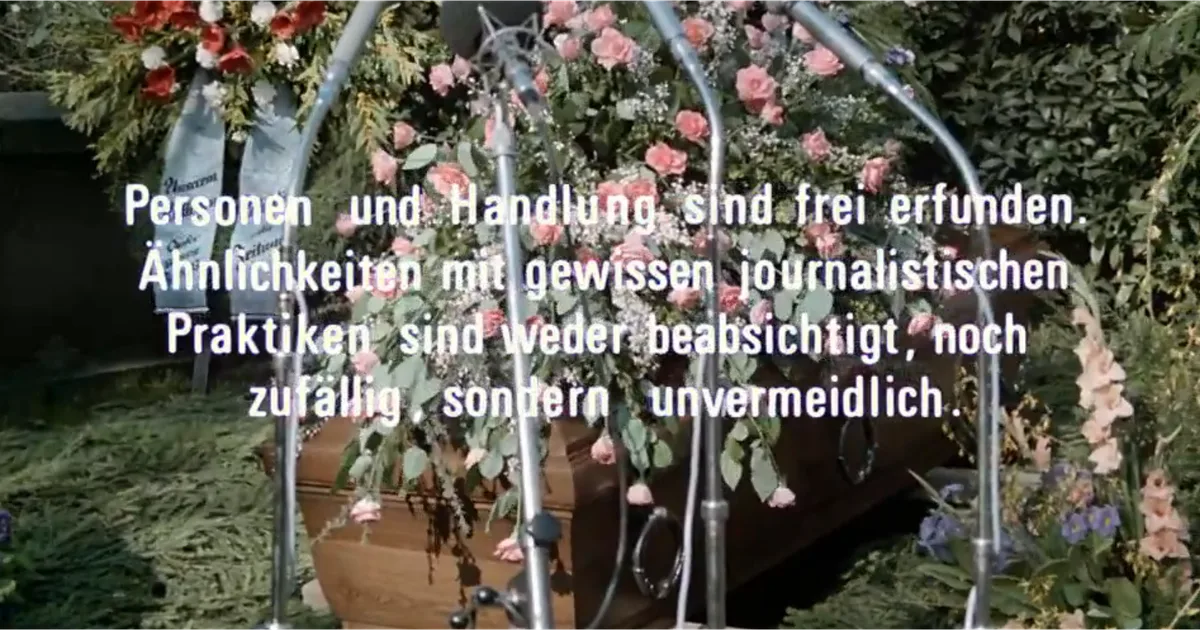
The novel ends with the murder of the journalist whereas the film ends at the funeral of the journalist with the newspaper editor delivering a speech about ‘freedom of the press’, presenting Blum’s act as a threat to the liberal social democratic order that the tabloid journalist had supposedly represented. The camera pans to the funeral flowers and a text appears over them:
The characters and action in this story are purely fictitious. Should the description of certain journalistic practices result in a resemblance to the practices of Bild-Zeitung, such resemblance is neither intentional nor accidental, but unavoidable.
In the years before the kidnapping of Nazi SS officer Hanns Martin Schleyer in September 1977 by members of the RAF that marked the beginning of the ‘German autumn’ an atmosphere of hysteria had already prevailed in the Bundesrepublik. All people on the left, even relatively moderate progressives, could be branded as violent terrorists. In 1971, a decree was issued against radicals in the civil service which came to be known as the Berufsverbot. The militant actions of groups like the RAF were used as a pretext for far-reaching police surveillance, raids and arrests. West German mass media, particularly the Springer Press, participated in creating and sustaining this atmosphere of political paranoia and repression. Writing in 1972, Oskar Negt and Alexander Kluge declared:
In the systems of the monopoly of the press, the mass media and the illusory public sphere, the actual social relations of power are reproduced. Thereby, cause and consequences are reversed. Since power has an effect upon the relations of power which have already been socially produced and internalized in individuals, an illusion arises as to who the perpetrator is, as to who is individually responsible for a crime. Therefore, it is not by chance that demented people and social outsiders appear as the perpetrators of violent actions. Their acts are prepared by a social production process which itself disappears in the act of violence.
The violence of the state is not just legitimised but denied and attempts to resist that violence are presented as not only illegitimate but as if they were purely irrational.
This is precisely the question at the heart of Antigone: if the law is unjust should it not be resisted? To repeat Anne Carson’s line: ‘Surely the community that outlaws an act of perfect piety is a community that has tipped over the edge into nonsense?’
II.
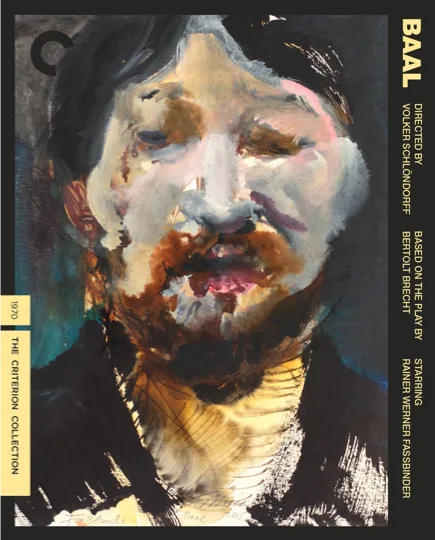
In 1970, von Trotta had starred alongside Rainer Werner Fassbinder in Schlöndorff’s made for TV film Baal based on the 1923 play by Bertolt Brecht but transposing the action to the present. Brecht’s widow Helene Weigel saw the film on TV and objected to the adaptation so it was not released or re-screened until 2014.
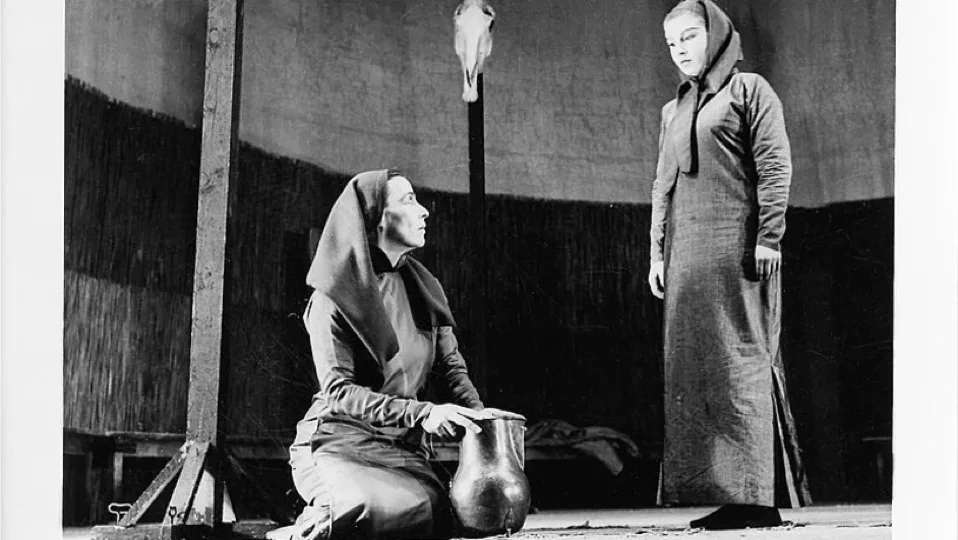
Weigel famously starred in Brecht’s version of Hölderlin’s adaptation of Sophocles’ Antigone in a production that opened in Chur, Switzerland in 1948. Premiering in the year he turned 50, this was Brecht’s first production post-exile and was an explicitly political staging. In a set deliberately devoid of overtly classical columns, the actors instead stood on a stage almost bear aside from horse skulls. In Germany in 1948 Hegel’s reading of the play that saw the validity of both Creon’s human laws and Antigone’s laws of the Gods was no longer tenable and Antigone was generally read as a figure embodying anti-fascist resistance. In Alfred Döblin’s novel November 1918, written in exile between 1933 and 1945, Rosa Luxemburg was cast as an Antigone-like figure.
Yet in Antigonemodell in 1948 Brecht expressed his frustration with such readings, claiming ‘the great character of the resister in the old play does not represent the German resistance fighters who necessarily seem most important to us.’ Antigone, a member of the ruling class did not represent the people, but was able to betray her class interests for moral and religious reasons. Ultimately, he says, she ‘has eaten all too long of the bread which was baked in the dark.’ Yet he still claimed that the tragedy must be performed in such as way as to ‘show the audience, as being a part of society, what is important for society in the story’. His poem ‘Antigone’ that was included in the play’s programme suggests he was not completely closed to the idea that the tragic heroine’s resistance could be transposed into the contemporary political moment:
Antigone
Come out of the twilight
And walk before us a while,
Kind one, with the light step
Of one whose mind is fully made up, terrible
To the terrible.
You who turn away, I know
How you feared death, but
Still more you fear
Unworthy life.
And you let the powerful get away
With nothing, and did not reconcile yourself
With the bewilderers, nor did you ever
Forget affront and let the dust settle
On the misdeed.
Salut!
III.
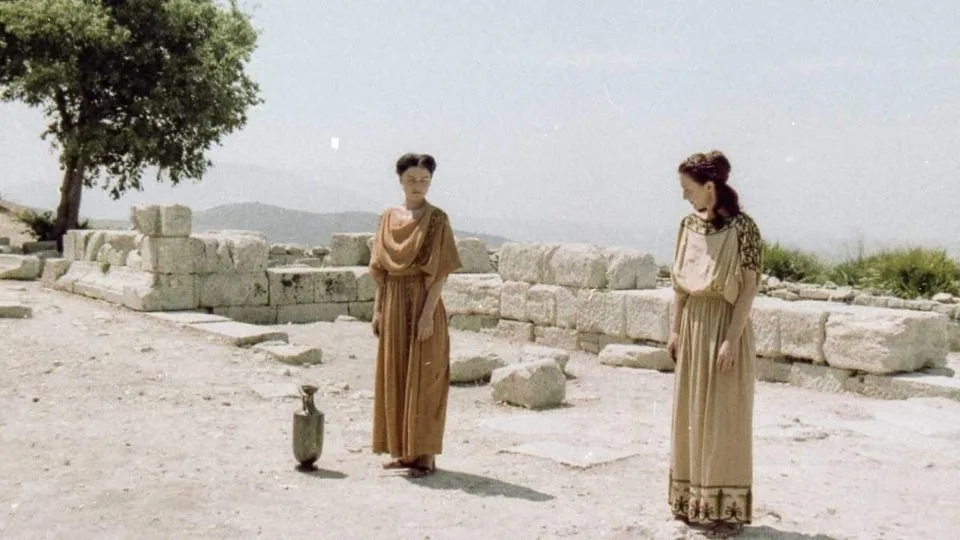
441 BC, 1800, 1948, 1991. Jean-Marie Straub and Danièle Huillet directed a version of Brecht’s Hölderin adaptation for the Schaubühne in Berlin two years after the fall of the wall. It was staged in a temporary venue in Kreuzberg in 1991 and later shot as a film in Sicily, which was released in 1992 as The Antigone of Sophocles / after Hölderlin’s Translation / adapted for the stage by Brecht / 1948. It was performed in classical dress in a rigorously Brechtian style with actors instructed to avoid ‘passion’ to enable more focus on the text than gestures. Though there is nothing overt in the staging that would suggest an analogy with the present Straub dedicated Antigone ‘to the hundred thousand, or more, we don’t even know, Iraqis we murdered’, a reference to the victims of the first Gulf War.
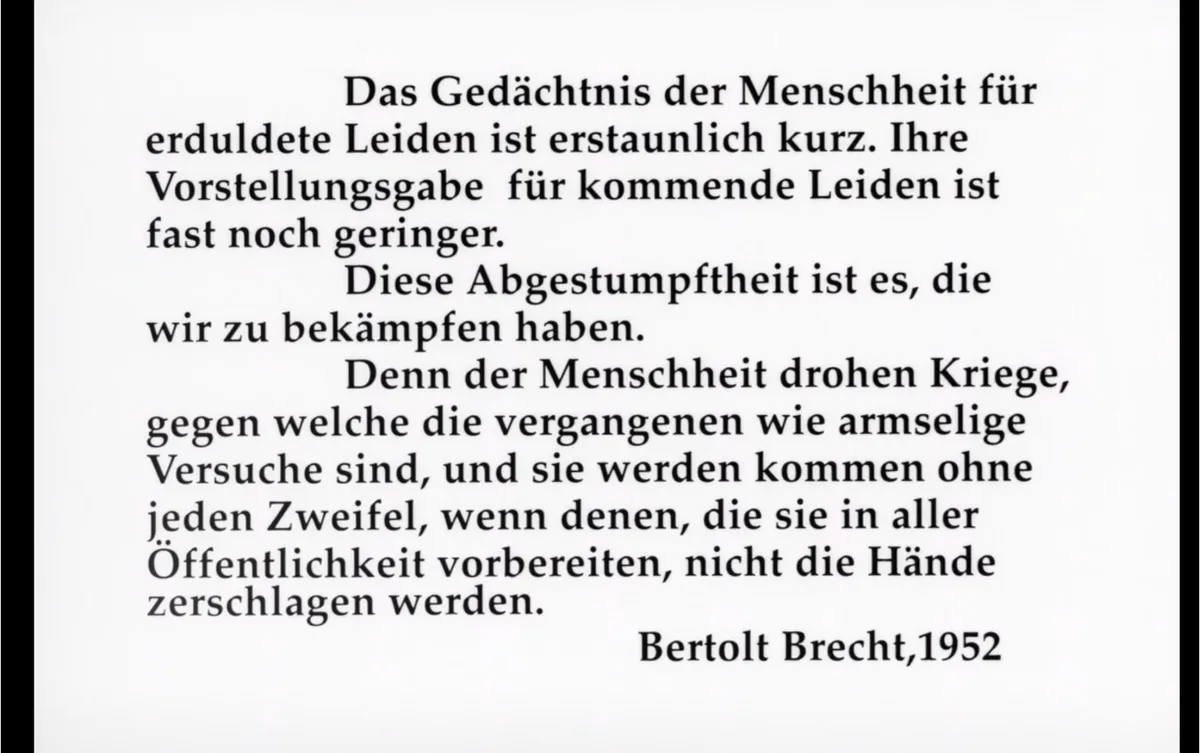
The film ends with an intertitle quoting Brecht from 1952 over which the sound of a helicopter can be heard:
The memory of humanity for sufferings borne is astonishingly short. Its gift of imagination for coming sufferings is almost even less. It is this callousness that we must combat. For humanity is threatened by wars compared to which those past are like poor attempts and they will come, without any doubt, if the hands of those who prepare them in all openness are not broken.
IV.
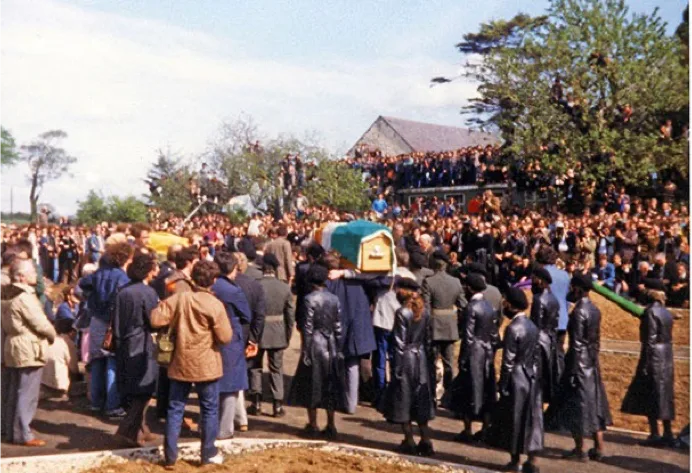
When the Irish poet Seamus Heaney adapted Sophocles’ play in a version he titled The Burial at Thebes, a translation which was first published and performed in Ireland in 2004, he claimed that he was not thinking of historical analogies when he worked on the play (unlike Tom Paulin’s 1980s adaptation The Riot Act) but later came to see that the question of burial and of mourning processes obstructed by the state – of people ‘unwept and unburied’ - were central to the politics of the north of Ireland during the troubles and of the plight of the IRA hunger strikers. As he reflected in an interview:
I’ve thought since of a moment, very close to my own home, during the hunger strikes in 1981, the second hunger striker to die in that IRA campaign of hunger striking was a guy called Francis Hughes whose parents lived very close, I knew his father, I knew his brothers and sister, I didn’t know him. But he died in the Maze Prison and of course, it was highly emotional time. He was a little Billy the Kid killer no doubt, but, it was inflamed politically, so the army, the security forces took control of the, after he died, he died in the prison, they took control of the body and didn’t allow any of the family or the local people who were near there, they delivered the body to Toomebridge which was a few miles away from his birthplace so there was kind of outrage at that. And it was the same kind of thing that, there was kind of Creon action there, where we’re taking charge of this body of the traitor, if you like, and at the same time there was the Antigone laws of the dead, of the family, piety and so on. So, there was kind of analagous energy on the ground in the north of Ireland for all that.
Here Creon is the British state; Antigone the Irish people.
In 2003 another Irish adaptation of the play by Conall Morrison the action was set in Palestine and, of course, there have been many Palestinian Antigone productions, including Adel Hakim’s 2011 Palestinian National Theatre staging in which some of the chorus’ lines replaced Sophocles with lines from Mahmoud Darwish’s poem ‘On This Earth’.
V.
Angela Winkler, who had played Katherina Blum in Schlöndorff and von Trotta’s earlier film, plays Antigone in the section of Germany in Autumn directed by Schlöndorff. The film was released in 1978 and consists of a series of segments addressing the ‘German autumn’ – including a long sequence near the beginning shot by Fassbinder featuring an intense dialogue with his mother and another by Kluge, whose contribution focuses on a history teacher, which was later expanded into a feature length film called The Patriotic Woman.
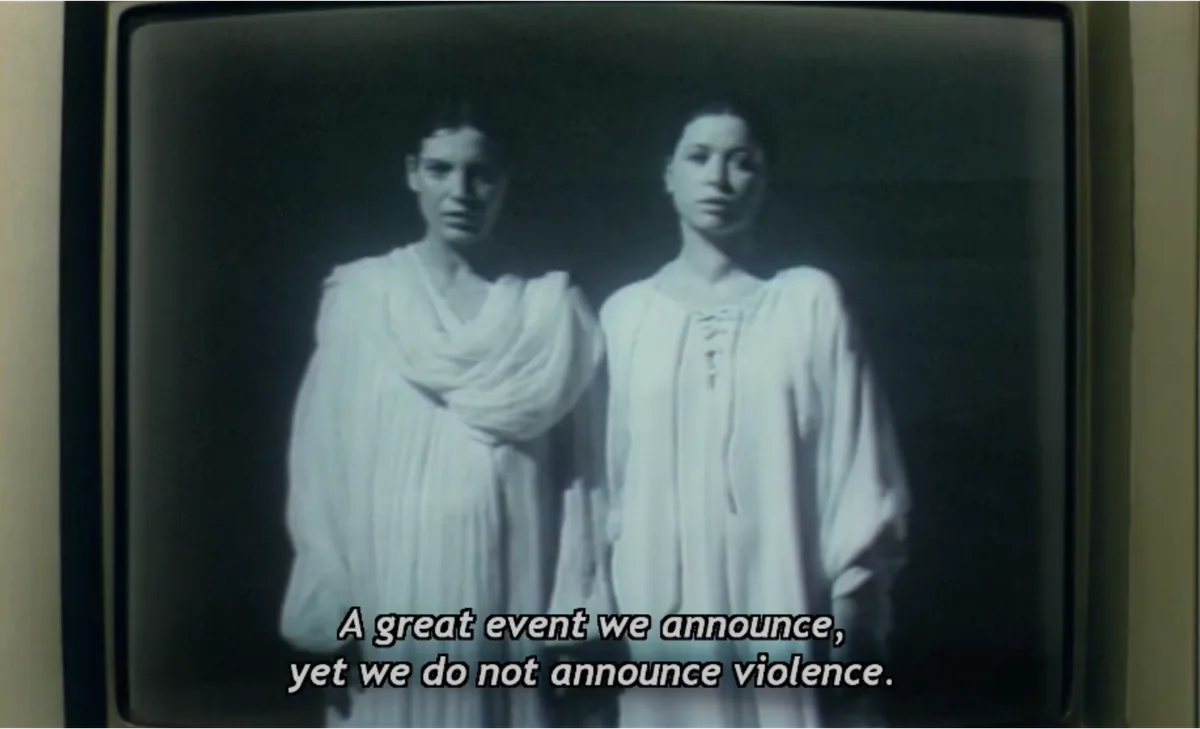
Antigone appears in Germany in Autumn as a TV play within a film. In this satirical segment, we see various TV producers and executives wringing their hands about whether it would be too incendiary to screen Antigone in the political climate of the German autumn given it is about, in their words, ‘a refusal to allow a burial’ and ‘rebellious women’. Before this debate ensues we see part of the opening scene of the play in which Antigone tells Ismene of her plan to disobey Creon’s decree in order to bury their brother.
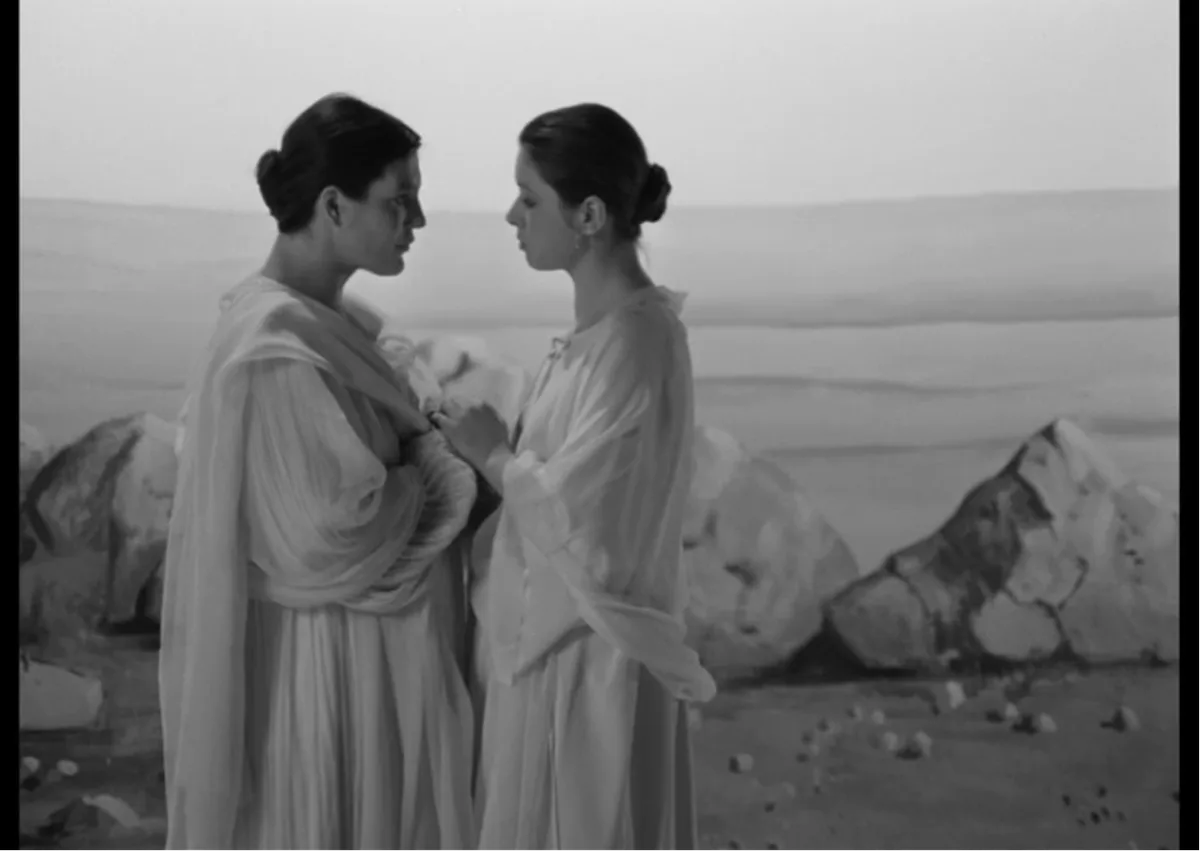
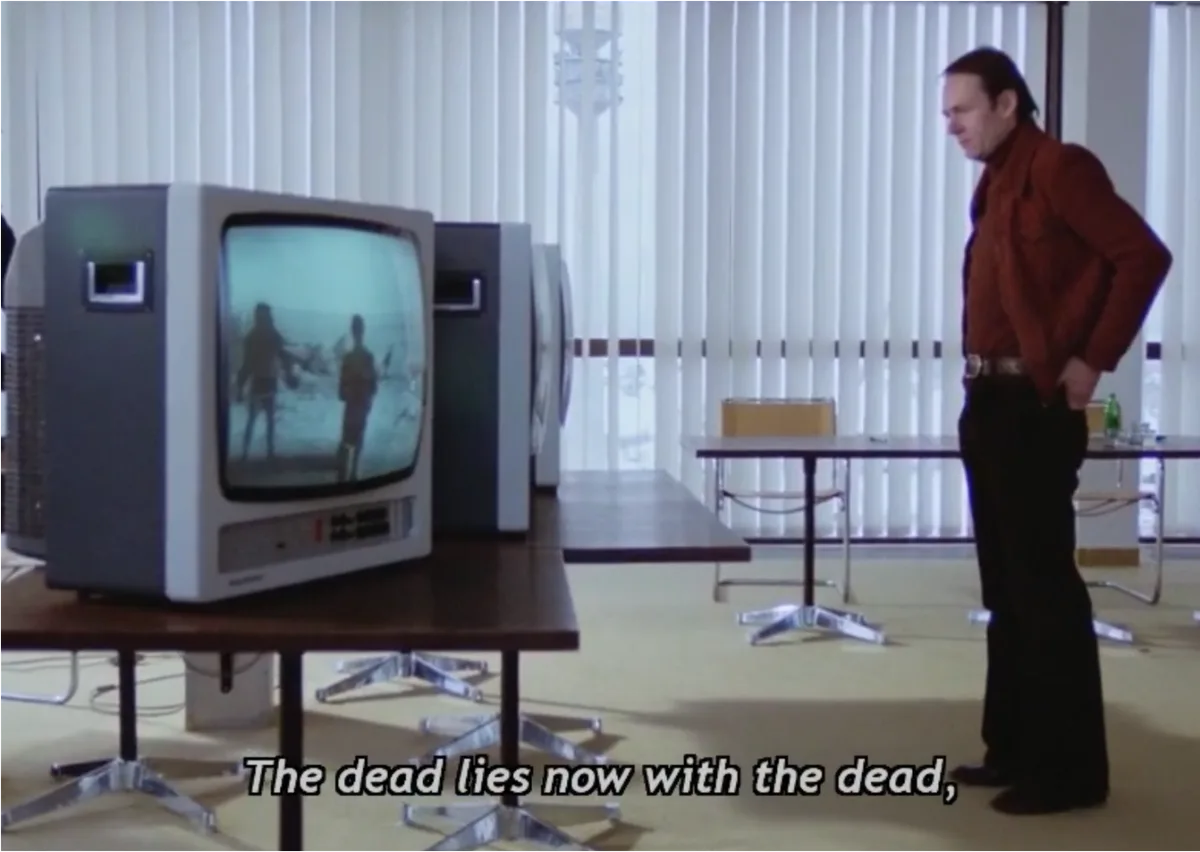
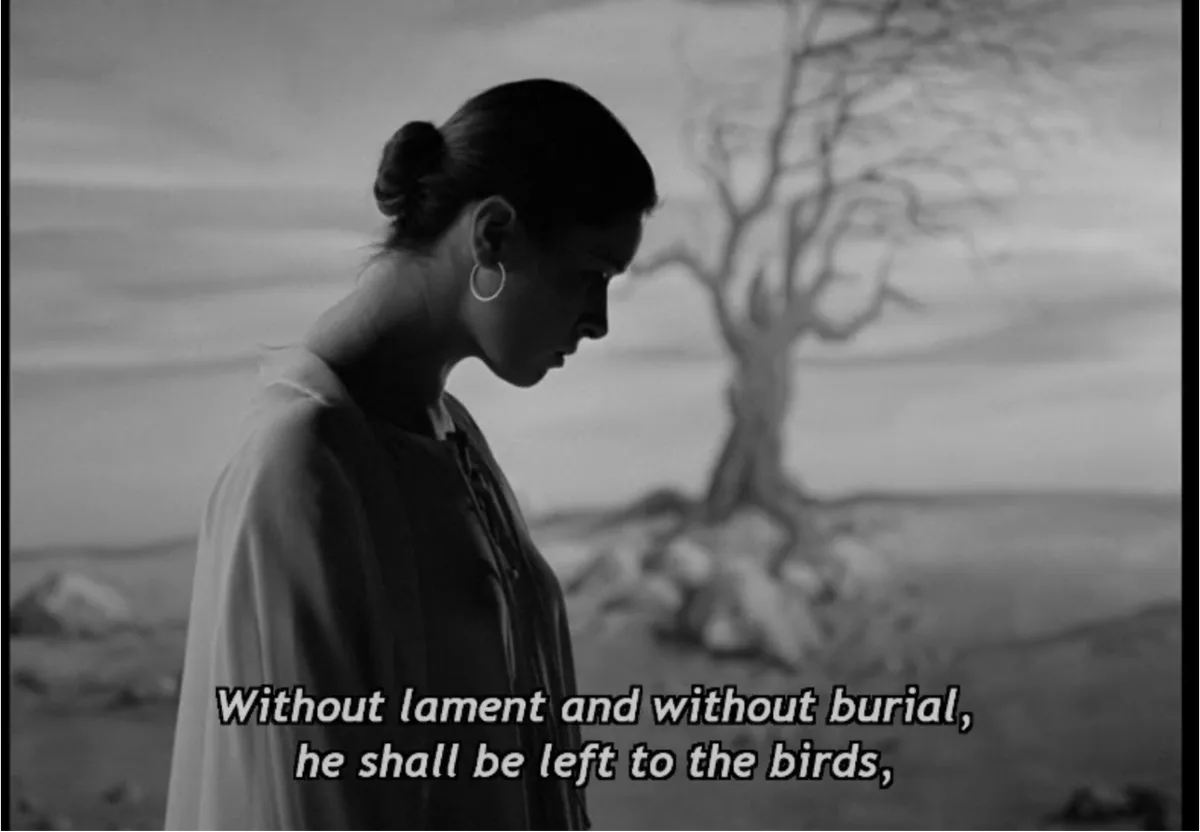
‘It’s simply too topical’ one of the executives declares in the discussion while others fear that censoring Sophocles sets a fascistic precedent. The director of Antigone shows the executives three disclaimers that might accompany the film each more absurd than the last with the final one showing the actors saying they ‘distance [them]selves from every form of violence’. The discussion in the television station is interspersed with short segments from the TV play. After it has been decided to delay the broadcast the TVs play the scene in which Antigone’s death is described and the camera slowly zooms in on the TV tower outside the window. As in Katharina Blum the media is shown to be complicit in state repression. This then cuts to a shot of the graves of RAF members Gudrun Ensslin, Andreas Baader and Jan-Carl Raspe, beginning a documentary sequence on the burial and funeral of the three RAF members. At a historical moment when many on the West German left were still committed to Palestinian liberation many of the attendees are wearing keffiyehs.
Germany in Autumn opens with documentary footage shot at the funeral of industrialist Hanns-Martin Schleyer - kidnapped and shot by the RAF in 1977 - and closes with scenes from the heavily policed and press-filled funeral of RAF members Ensslin, Baader and Raspe, who were all found dead in their cells at Stammheim prison and eventually buried in a common grave. An interview with Ensslin’s sister is shown in the film who describes the difficulty of finding a place to bury the three together in Stuttgart and how the state attempted to preserve their outsider status even in death.
The Antigone analogy is clear. Creon is the voice of the German state:
he shall have no grave
no one will bury him
no one will mourn him
no one will utter a cry
The state obstruction of a burial also obstructs the process of mourning.
VI.
Margaretha von Trotta claims she was inspired to make her 1981 film Die bleierne Zeit (1981) (literally The Leaden Time, which was released in Britain as The German Sisters and in the US as Marianne and Juliane) after meeting Gudrun Ensslin’s sister Christiane at the funeral that is shown in Germany in Autumn.
Die bleierne Zeit focuses on Juliane (played Jutta Lampe), who works for a feminist women’s magazine, and her relationship with her sister Marianne (played by Barbara Sukowa), an activist in a West German militant left-wing organisation loosely based on the RAF, who is arrested, imprisoned in solitary confinement and finally found hanged in her jail cell. Juliane, wracked with grief, sets out to prove that this was not suicide but a murder orchestrated by the state. I saw von Trotta introduce this film in Berlin a few years ago and she said this was something everyone on the German left believed at that time.
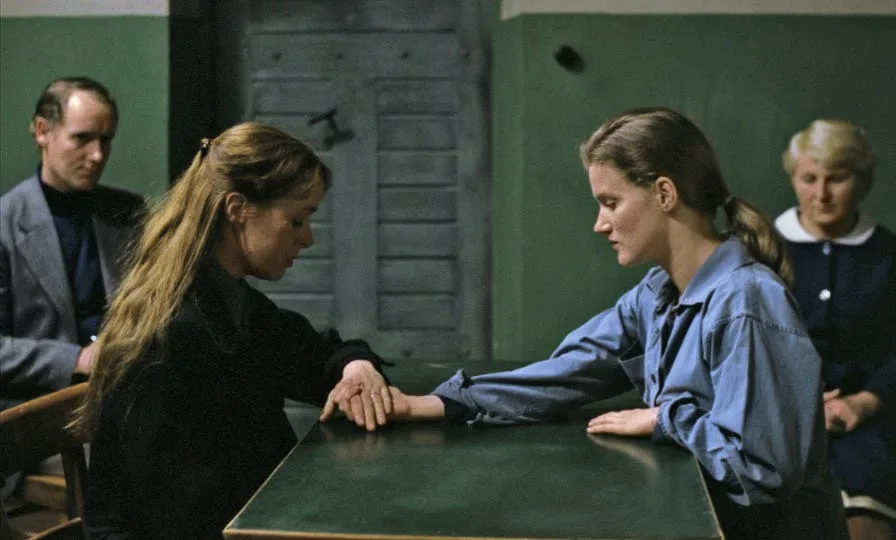
Ensslin was imprisoned along with other RAF members in solitary confinement in Stammheim Prison, not only isolated in their cells but kept in ‘dead-wings’ devoid of other prisoners. During one of her visits Juliane expresses concern at Marianne’s weight loss, the result of a hunger strike, but Marianne retorts that her sister cannot understand what it means to endure solitary confinement in a cell where the lack of windows and constant glare of artificial light make it impossible even to differentiate night from day: ‘Silence is different here’, she says, ‘You lose all sense of time and, ultimately, of self.’
At one of their last meetings Marianne has been transferred to a prison where Juliane must speak to her through a glass partition. Juliane’s reflection briefly overlaps with Marianne’s as if, for a brief moment, their fates are united. The implication seems to be that either sister could have been in the other’s place.
Five Palestine Action activists - the Ulm 5 - are currently being held in pre-trial detention at Stammheim prison where members of the RAF were incarcerated. They are being tried as a ‘criminal organization’ rather than for committing property damage. Their lawyers have argued that hosting the trial at Stammheim is intended to associate the activists with the RAF.
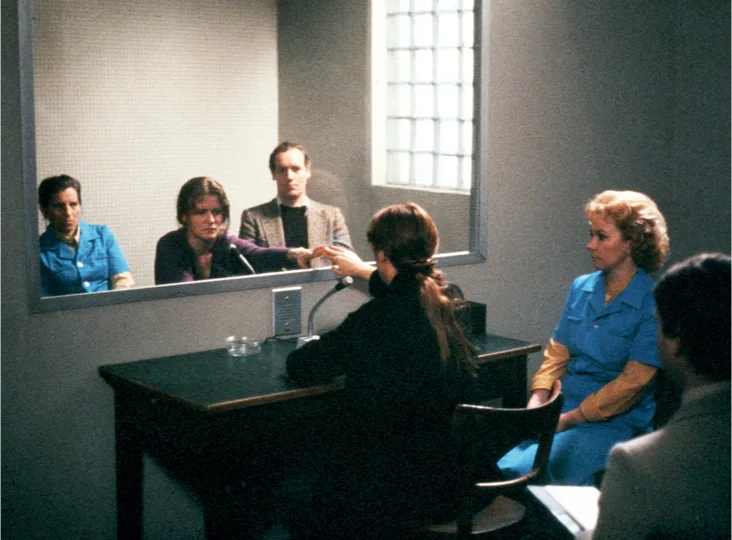
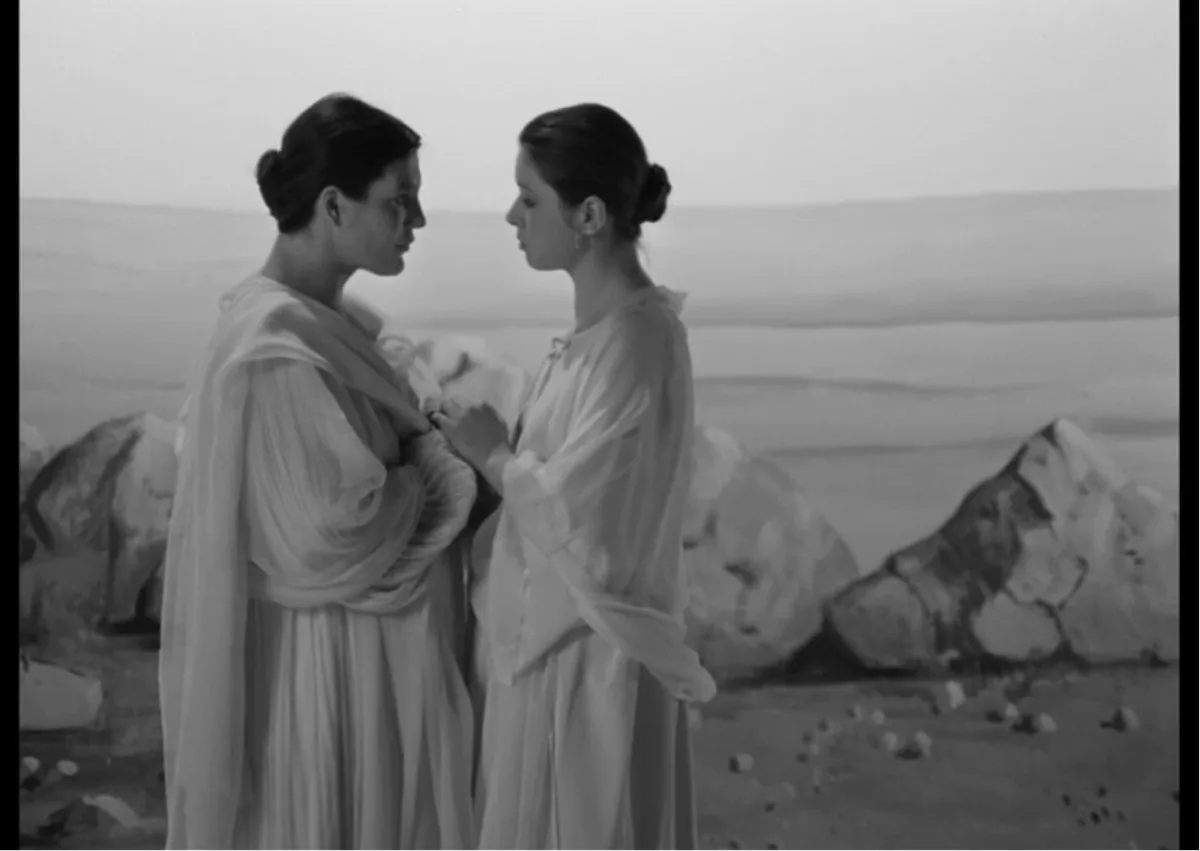
The scene directed by Schlöndorff in Germany in Autumn suggests that the members of the RAF could potentially be compared both to the ‘unwept and unburied’ Polynicus and the rebellious Antigone who insists on performing the burial rites. The German Sisters is more like Antigone from the perspective of her sister Ismene. At the beginning of the play Ismene is critical of Antigone’s actions despite sympathy with her motives. In the opening scenes she says to Antigone:
you always push the limit
limits are there for a reason
And a few lines later:
you are someone in love with the impossible
But by the end of the play, like Christiane Ensslin (and the fictional Juliane) who fought on behalf of her sister, she says she wants to die with Antigone.
Ultimately for Ismene, as for Juliane/Christiane, despite being critical and anxious about the repercussions of resistance, she comes to see her sister’s unlawful act as being more just than the laws and violence of the state. She attempts to confess to Creon that she too committed the unlawful act to which Antigone initially responds with anger – ‘I don’t like this sudden sympathy of yours it’s all words’ – but Ismene seems sincere
please, sister, do not exclude me from the right
to die with you and share our brother’s requiem
She says she wants to help Antigone and reminds her that she had begged her not to act but Antigone is very clear that she was well aware that death awaited her if she disobeyed the law.
In the Brecht/Hölderlin version Ismene begs Antigone to ‘Let be what’s past’. Antigone replies:
You are younger, you have seen
Less horror. What is past, let be
Does not stay past
Antigone is clear that the injustice and violence of the past will continue into the future without her intervention. ‘What is past let be / Does not stay past.’
VII.
One of the IRA prisoners who went on hunger strike along with Bobby Sands and Francis Hughes in the early 1980s, Laurence McKeown published an article in January 2026 reflecting on their actions, which responded to legislation introduced by the British government, expanding British police power to arrest and interrogate suspects and leading to trials without juries. The government withdrew the prisoner’s Special Category status meaning they were treated as criminals rather than prisoners of war. McKeown drew a parallel between the IRA hunger strike, the treatment of political prisoners by the British state and the shifts in state legislation that enabled a harsher state response to political prisoners during the Troubles to the recent hunger strike conducted by members of the direct action group Palestine Action. He wrote:
It’s not that those protesting injustice, oppression, and in this case, genocide, have overnight become terrorists, but that the British government, for political reasons, wants to depict their actions as such – just as they did here in Ireland.
[NB. I wrote the following paragraphs in February 2026 just after six of the Filton activists were acquitted by a jury. Much more has unfolded since then. There was a retrial in May 2026 and a jury convicted some of the activists of a minor charge of criminal damage, without being told that a terror connection would later be applied by a judge at sentencing. They were sentenced on June 12 2026. Peter Hallward has written a detailed article discussing the case that is well worth reading, including a discussion of controversies over the judge and his attempt to prosecute the defence lawyer.]
On 6 August 2024 a group of activists in Palestine Action broke into the factory of the defence firm Elbit Systems near Bristol. They were involved in ‘a direct action protest at Elbit Systems UK’s £35 million research and development site in Filton. Armed with sledgehammers they are reported to have caused more than £1 million in damages. Elbit’s parent company supplies up to 85% of the land-based equipment and drones used by the Israeli military, according to the Database of Israeli Military and Security Export.’ Some of the 24 arrestees were held on remand for over a year before being charged. Six of them appeared in court early this year charged with aggravated burglary, criminal damage and some with the additional charge of violent disorder. Since their action and arrest, Palestine Action was proscribed as a terrorist organization in the UK [the high court overturned the ban but it was then found to be lawful by the court of appeal].
On the 5th February 2026, a jury acquitted the group of aggravated burglary and violent disorder and could not come to a decision on the charge of criminal damage. The jury refused to convict the defendants of any charge. During the trial the jury passed a note to the judge that read: ‘If we decide that they genuinely believe that they were performing life-saving action and were morally compelled to destroy weapons they believed were going to be used to kill civilians in what they believe to be an illegal genocide, would that amount to a lawful excuse?’
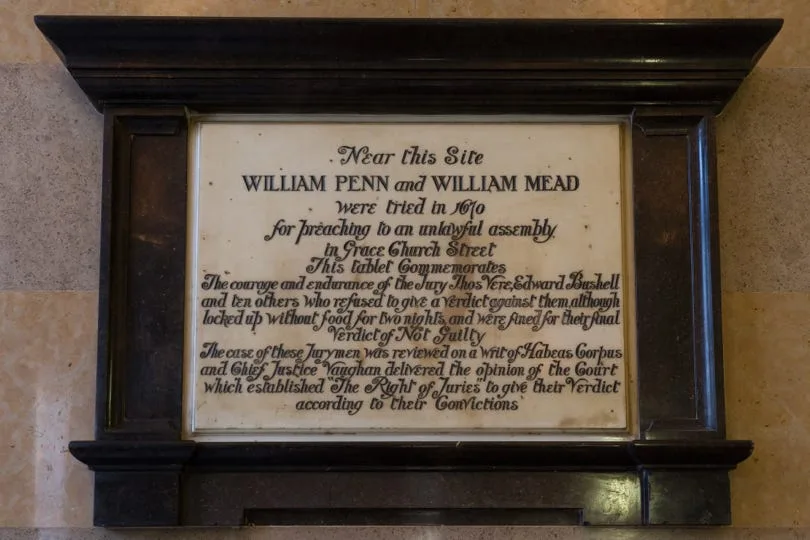
In English law ‘lawful excuse’ can be applied to cases where property damage was deliberately committed in the interests of safety. The judge officially withdrew ‘lawful excuse’ in this case but the lawyer of Charlotte Head, one of the six activists on trial, Rajiv Menon informed the jury that under English law: ‘No judge in any criminal case is allowed to direct a jury to convict any defendant of any criminal charge, whatever the evidence might be.’ Menon cited a case from 1670, when Quakers William Penn and William Meade were prosecuted for preaching to a gathering outside of a Church of England building, which at that time was unlawful. The jury was directed by the judge to find them guilty but they refused. This case became the basis of a law now commemorated on a plaque inside the Old Bailey in London which says: ‘Chief Justice Vaughan delivered the opinion of the court, which established the right of juries to give their verdict according to their convictions.’ [For doing this Menon was referred for contempt of court, which he subsequently successfully appealed. The jury at the retrial were not told that if they found the defendants guilty that they would be charged under terror legislation.]
Ismene: Kreon says the act is unlawful
Antigone: Antigone says it’s not Kreon’s business
In Antigone Creon changes his mind about Antigone’s punishment but realises his mistake too late - ‘bad judgment can do great harm’ – Tiresius tells Creon he will pay the price for his misdeeds, for violating the rules of the gods.
it is so wrong
it is so wrong
In the world of mortal law such an outcome isn’t guaranteed. As Brenna Bhandar points out, during the genocide international laws have repeatedly and brazenly been broken by the Israeli state in Gaza for which they have not been held accountable:
With no shortage of legal rulings and academic opinions on the illegal nature of the particular and gross forms of violence the Israeli state is inflicting on the people of Palestine… the question of impunity looms large.
On June 15 2026, the court of appeal ruled the UK Home Secretary’s proscription of Palestine Action to be lawful (after the high court had overturned the ban).
‘Surely the community that outlaws an act of perfect piety is a community that has tipped over the edge into nonsense?’
VIII.
Brecht objected to the role of fate in Greek tragedy. Rather than being preordained by the gods, as a historical materialist he insisted that people could intervene in the course of history. In fragment B13 of Buying Brass, Brecht’s Philosopher character observes, ‘The causes of a great many tragedies are outside the control of those who suffer them, or so it seems … [But] that which is human cannot be outside of humanity’s control.’
Yet the action of Antigone is not completely subordinated to external fate. Antigone appeals to the eternal laws of the gods but it is she who chooses to intervene. When Tiresieus appeals to Creon, the avatar of state power, he also does so by invoking his capacity to act and change course:
the cause is you
you bring this sickness on the city
you gave that body to the birds and dogs so that
our hearths and alters are defiled
of course the gods have turned away from us
of course the birds are shrieking unintelligible things
their mouths are gorged with guts and blood
my child, take heed
to err is human
but to persist in error is imprudent unlucky and just stupid
In 2022 after 18 months of direct action Elbit Systems announced it was selling its factory in Oldham. Later that year, following 15 actions, they closed their London offices on Kingsway. Elbit sold off its subsidiary formerly called Elite KL in 2024, which operated out of a site in Tamworth after its profits reportedly dropped by 75% as a result of increased spending on security. The Elbit Systems UK site in the Aztec West business park also reportedly closed in 2025. In January 2026 Elbit Systems UK was denied a £2 billion training contract with the Ministry of Defence. Peter Hallward quotes a news story reporting that ‘Elbit System UK’s latest accounts show that it made an operating loss of £4.7m [in 2024], compared with a profit of £3.8m in 2023.’
Following her sentencing in June 2026, it was reported that Charlotte (Lottie) Head shouted the words of the Palestinian poet Marwan Makhoul: ‘In order to hear the birds, the warplanes must be silent.’
In Darwish’s poem that was inserted into Hakim’s 2011 production of Antigone ‘clouds imitating a flock of creatures’ are among the things that make life on this earth worth living.
In Antigone the birds pecking at the unwept and unburied dead attest to the violation of divine law. Tiresius warns Creon that if he refuses to bury his son there will be consequences: ‘there will be tumult of cities and hatred against you / dogs and birds and body parts…’ In Antigone the ‘race of birds’ belongs to that realm of things - dogs and underwater creatures and wild horses - that humanity has sought to stifle and control.
Birds are the antithesis of unjust human laws. Birds are the antithesis of warplanes.
But if ‘that which is human cannot be outside of human’s control’ it will be the actions of people that silence the warplanes and make it possible to hear the birds again.
*
Thanks to Nadine Hartmann and Sami Khatib for inviting me to present something about Antigone earlier this year. Though I’ve edited it and added stuff since, I originally wrote this to accompany a screening of Germany in Autumn though. All the Antigone quotations are from Anne Carson’s translation. Some fragments from this are drawn from an article I wrote for Another Gaze on von Trotta.