16 January 2026
Charlotte Corday's skull
In November I was in Brussels for work and tried to see Jacques-Louis David’s Death of Marat at the Royal Museums of Fine Arts of Belgium only to find that the museum was closed due to a public holiday and that the painting was on loan to the Louvre anyway. I sat on a nearby bench and read my book instead. I’ve just returned from a short trip to Paris where I had booked to see the David exhibition but Louvre workers were on strike (protesting staff conditions, building deterioration and other issues) so it wasn’t possible. I hope they win. On the Eurostar before we’d heard about the strike, me and my friend nerdily re-read TJ Clark’s discussion of The Death of Marat in ‘Painting in the Year 2’, the first chapter of his 1994 book on modernism Farewell to an Idea. I then remembered that once upon a time I’d written something about the skull of Marat’s assassin, Charlotte Corday, in response to a couple of paintings that I had actually seen. I have decided to exhume it.
Below is an essay that was originally delivered as a paper at Historical Materialism way back in - yikes - 2015 and then developed into an essay that was published in the 2017 book Objects of Feminism, edited by Maija Timonen and Josefine Wilkström. This is one of three essays that I’ve published on women and political violence over the last decade and I have at some points thought I might want to write a whole book on the theme. (The other two essays are Women on the Edge for Another Gaze in 2019 (on Marge Piercy’s novel Vida and the Margerethe von Trotta film Marianne and Juliane (Die bleierne Zeit)) and ‘“Sadistic, grinning rifle-women”: Gender, emotions and politics in representations of militant leftist women’ in the open access book Gender, Emotions and Power, 1750–2020, edited by Hannah Parker and Josh Doble, published in 2023, which is a bit about Gerwani women in Indonesia, a bit about Klaus Theweleit’s Male Fantasies and a bit about les pétroleuses in the Paris Commune.)
The spirit is a bone.
G.W.F. Hegel, Phenomenology of Spirit
Corpse (of a woman)
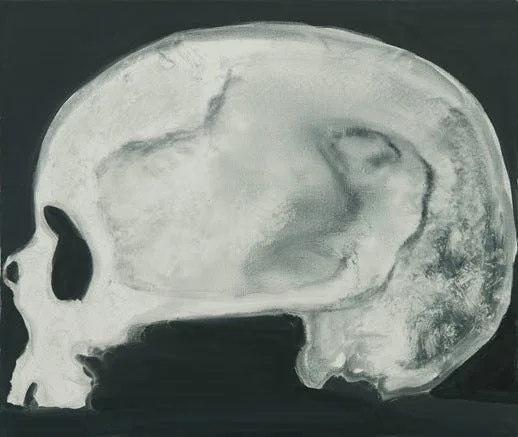
In the final room of a Marlene Dumas exhibition at Tate Modern in 2015 hung two paintings: Stern (2004) depicting the head of the corpse of Red Army Faction co-founder Ulrike Meinhof and Skull (of a Woman) (2005), which showed the skull of Charlotte Corday who assassinated the Jacobin leader Jean-Paul Marat in 1793. The coincidence of these two paintings, which both feature the dead bodies of women who committed violent acts for political ends, prompted me to analyse them alongside one another. In both examples, inert bits of corpse took on posthumous lives but not, however, lives of their own. Scientists scrutinised both Corday’s skull and Meinhof’s brain in the hope of shedding light on the violent political acts the two women had committed; acts which, despite their very different political motivations, were deemed to conflict with the supposedly natural predispositions of healthy women. By emphasising abnormality, pathology and deviance, these bits of matter were interpreted in ways that bolstered existing normative assumptions about gender, active political engagement and violence. The scientific analyses of these specific lumps of flesh and bone thus reveal more about the social values that mattered to those analysing them than they do about the women from whose bodies they originated. And the tensions between matter and meaning, nature and culture, and essences and ideas evident in analyses of Corday’s skull and Meinhof’s brain are also at stake in the making, re-making and un-making of gendered identities among the living.
Meinhof’s brain
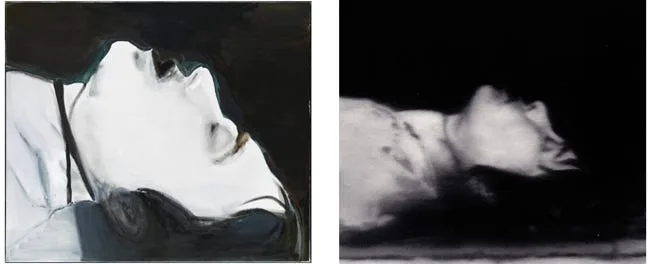
Ulrike Meinhof was found hanged in her prison cell on May 9th 1976. The death was ruled a suicide. Her brain was removed and secretly preserved in a jar of formalin for posthumous analysis. Meinhof’s brain had been the site of intense speculation since she became involved with the Red Army Faction in 1970, as she had undergone brain surgery in the early 1960s. Photographs of the X-Ray of her brain taken at the time of her hospitalisation, which were first published in a scientific journal in the late 1960s, appeared in the mainstream press in 1972. Could the engorged blood vessel in her cerebral cortex and the subsequent operation explain her ‘slide into terrorism’? Could the armed struggle in Germany be attributed to neuropathology? Many in the West German press, as well as Meinhof’s estranged husband, speculated that it could. Why else, they reasoned, would an educated middle class woman, a mother no less, advocate radical political violence? In lieu of her fingerprints, the metal clamp in Meinhof’s brain was used by police to identify and then arrest her. Charity Scribner discusses the dramatic change in Meinhof’s appearance and public image after she was imprisoned: ‘grey uniforms, hacked-off hair, and hunger strikes transformed her image from that of a poised intellectual into a raging lunatic, an enemy of the state.’ Meinhof’s distressing and fragmentary letters from prison suggest that her imprisonment prompted an internal as well as an external transformation: ‘The feeling that your head is exploding (the feeling the top of your skull should really tear apart, burst wide open)- / The feeling your spinal column is pressing into your brain- / The feeling your brain is gradually shriveling up, like baked fruit…’ However, according to official public debates these experiences did not originate in the prison cell but in Meinhof’s cerebral tissues. As Amanda Third discusses:
[By] consolidating the link between her brain surgery and her ‘conversion’ to violent politics, the state sought to construct Meinhof’s terrorism as pathologically motivated. In this sense, her brain surgery constituted, for the state, an opportunity to contain her actions within a familiar narrative about both women’s (and terrorists’) fundamental irrationality. Meinhof’s politics and her identity as a female political terrorist were constructed as a neurological dysfunction, a sign of peculiarly feminine madness.
According to Third, it was hoped that analysing Meinhof’s brain would give insights not only into her psychology as an individual but into the motivations and proclivities of all terrorist female subjects. The fascination evinced in Meinhof’s brain is, Third argues, continuous with broader constructions of the female terrorist as pathological and deviant, and hence as one whose actions and opinions can be delegitimised, read as crazy. Third, however, displays little interest in the specific content of Meinhof’s political views. Meinhof is presented as being against the state and status quo but these entities seem curiously transhistorical, static and culturally unspecific, which makes it possible for Third to imagine a homology between all acts of so-called terrorism committed by women and, concomitantly, between the various things they might attack. The example of Charlotte Corday complicates Third’s thesis because despite her violence Corday was politically ‘moderate’; her relationship to the ‘social order’ to which Third imagines all terrorists pose a threat was not straight-forwardly disruptive in that she sought to halt rather than unleash a revolution. Instead, the target of her violent act – and, ironically, its outcome – was ‘terror’. Nonetheless the most prominent analysis of her skull, though sympathetic to her actions, still sought to find a physical basis for describing violent and politicised women as pathological.
Hybrid creatures
The same well-worn story of Corday’s assassination of Jean Paul Marat has been told and re-told. Across two centuries the key moments of the murder rarely alter - the chronology and even the script of the meeting between Corday and Marat is firmly established and rarely deviated from. What changes are the details. There are lots of versions of Corday – honest or duplicitous, a calm and steadfast patriot or a frenzied counter-revolutionary, a virginal victim or a violent virago. Her contemporaries variously likened her to Joan of Arc, to Judith who decapitated the Assyrian general Holofernes, to Caesar’s assassin Brutus, and to heroines from the works of Corneille (to whom she was distantly related). Sometimes she appears as the antithesis of revolutionary virtue and sometimes its apotheosis. Even her hair colour is inconsistent: auburn, brunette, ash blonde; sometimes natural, sometimes powdered. It is these small differences between accounts that make it possible to distinguish the contemporary Jacobin commentators who were repulsed yet fascinated by Corday from the verbose nineteenth-century conservative historians who saw her as naive yet principled, the 1930s Soviet historians who cast Corday as a crafty class enemy from the American feminists of the late twentieth-century obsessed with the gendering of public and private spheres who claimed Corday as an active political agent. Indeed, contradictions often exist within individual descriptions of Corday. In 1837 Thomas Carlyle described her as beautiful yet ‘squalid,’ ‘angelic-demonic’. Jules Michelet, writing 18 years later, as ‘masculine in expression but delicate in features’. Such ambivalence was also evident in analyses of her skull.
Corday was executed on 17th July 1793 (the revolutionary calendar would only be introduced in October of that year). Four days earlier she had assassinated ‘Friend of the People’ Jean Paul Marat in his bathtub. Her skull, however, only appeared in public 96 years later at the 1889 Exposition Universelle in Paris, which marked the centenary of the revolution. Dumas’s painting seems to have been based on a photograph taken on that occasion. Like Meinhof’s brain, Corday’s skull was examined by scientists to provide insights not only into her individual psychology but into female criminality in general. ‘The skull before my eyes is yellow like dirty ivory; it is shiny, smooth,’ ran one description by the French craniologist Paul Topinard. He claimed that the skull betrayed no abnormalities or ‘pathological deformation’ and instead declared that it was it just like any woman’s skull: ‘It is a beautiful skull, regular, harmonic, having all the delicacy and the soft, but correct curves of feminine skulls.’ Topinard argued that the specimen displayed no signs of innate deviance. Instead he set out to attack contemporary scientific assumptions about the relation between skulls and psychology (although he still maintained Corday’s skull was inherently ‘feminine’).
Topinard’s analysis was, however, vehemently repudiated by the prominent Italian phrenologist Cesare Lombroso. Lombroso asserted that a person’s propensity for crime could be gleaned from the shape and ‘abnormalities’ of their skulls; that criminals were physically distinct from and inferior to non-criminals. His discussion of Corday’s skull is included in his The Criminal Woman, the Prostitute and the Normal Woman (1893) in which he attempted to delineate a boundary between ‘normal’ and ‘deviant’ women (although in his system only non-criminal white men were fully ‘normal’ as even the most virtuous women were said to exhibit ‘innate depravity’ and ‘slight criminal tendencies such as vindictiveness, jealousy, envy, and malignity.’) Unlike the most maligned figure in his book, the prostitute, whom Lombroso treats as a kind of separate degenerate species, Corday is cited as an example of a woman who committed ‘the purest political crime’. But, in distinction to Topinard, Lombroso claimed that despite her beauty and the nobility of her crime a large number of ‘cranial abnormalities’ marked Corday out as a natural born killer.
While Lombroso, in contrast to the West German analysts of Meinhof’s brain, ennobled men who committed crimes of passionate conviction, he insisted that their female equivalents were atavistic: ‘premeditation and savagery play a greater part in women’s than men’s crimes of passion.’ ‘Colder and more cunning’ than their male equivalents and less likely to repent, such criminals displayed some distinctly ‘masculine’ ‘moral traits’ including,’ he says, a ‘love of firearms.’ Had Marat’s murder been committed by a man Lombroso may have approved, but Corday’s gender rendered the act a deviation from nature. Examples from the animal kingdom are cited as evidence to bolster Lombroso’s claims regarding women’s natural propensity for frenzied violent behaviour. For example, female ants, he says, are known to commit crimes of passion: they ‘sometimes crush another ant’s head with their mandibles and squeeze it to death.’ Indeed, the female creatures Lombroso claims are particularly prone to criminality – ants and bees – should not strictly be considered female at all, so distinctly unfeminine are their acts. Instead he proposes they constitute a ‘third sex.’ Lombroso sought to show that passionate criminal Corday, like the warrior ant and pillaging bee, transgressed his imagined masculine-feminine binary.
Lombroso’s characterisation of Corday as someone not properly ‘female’ is part of a long history. Historian Erica Rand has argued that Corday’s act was understood as a transgression of gender norms by her contemporaries regardless of their political persuasions: ‘People either saw a woman and could not see a political actor or saw a political assassin and could not quite call her a woman’; they either ‘depoliticis[ed] the woman or defeminis[ed] the patriot killer.’ This accords with Third’s general claims about the figure of the female terrorist as a troublingly oxymoronic figure: simultaneously ‘hyperterrorist’ and ‘hyperfeminine’. In the aftermath of Marat’s assassination an article was published in the Gazette de France Nationale and reprinted for distribution by the General Council of the Department of Paris which described Corday as a woman who ‘had thrown herself absolutely outside of her sex.’[Meanwhile, the Marquis de Sade proclaimed:
Soft and timid sex, how can it be that delicate hands like yours have seized the dagger whetted by sedition?... Marat’s barbarous killer, like one of those hybrid creatures to whom the terms male and female are not applicable, vomited from the jaws of Hell to the despair of both sexes, belongs directly to neither. Her memory must be forever shrouded in darkness and above all let no one offer us her effigy as some dare to do, in the enchanting guise of beauty. O too credulous artists break to pieces, trample under foot disfigure this monster’s features, or only offer her to our revolted eyes pursued by Furies from the underworld.
Sade’s invocation of ‘hybrid creatures’ recalls Lombroso’s ‘third sex’: Do not be deceived! Corday may look like a woman but she – he? it? – acts like a man; outer appearance belies inner reality. These anxieties about Corday’s failure to slot neatly into a pre-determined gender identity are redolent of anxieties about a different kind of pre-determined binary: the distinction between nature and artifice, a distinction that was central to French revolutionary discourse and which, like the supposedly empirical distinction between male and female, proved worryingly difficult to pin down.
Truths inhering in the world
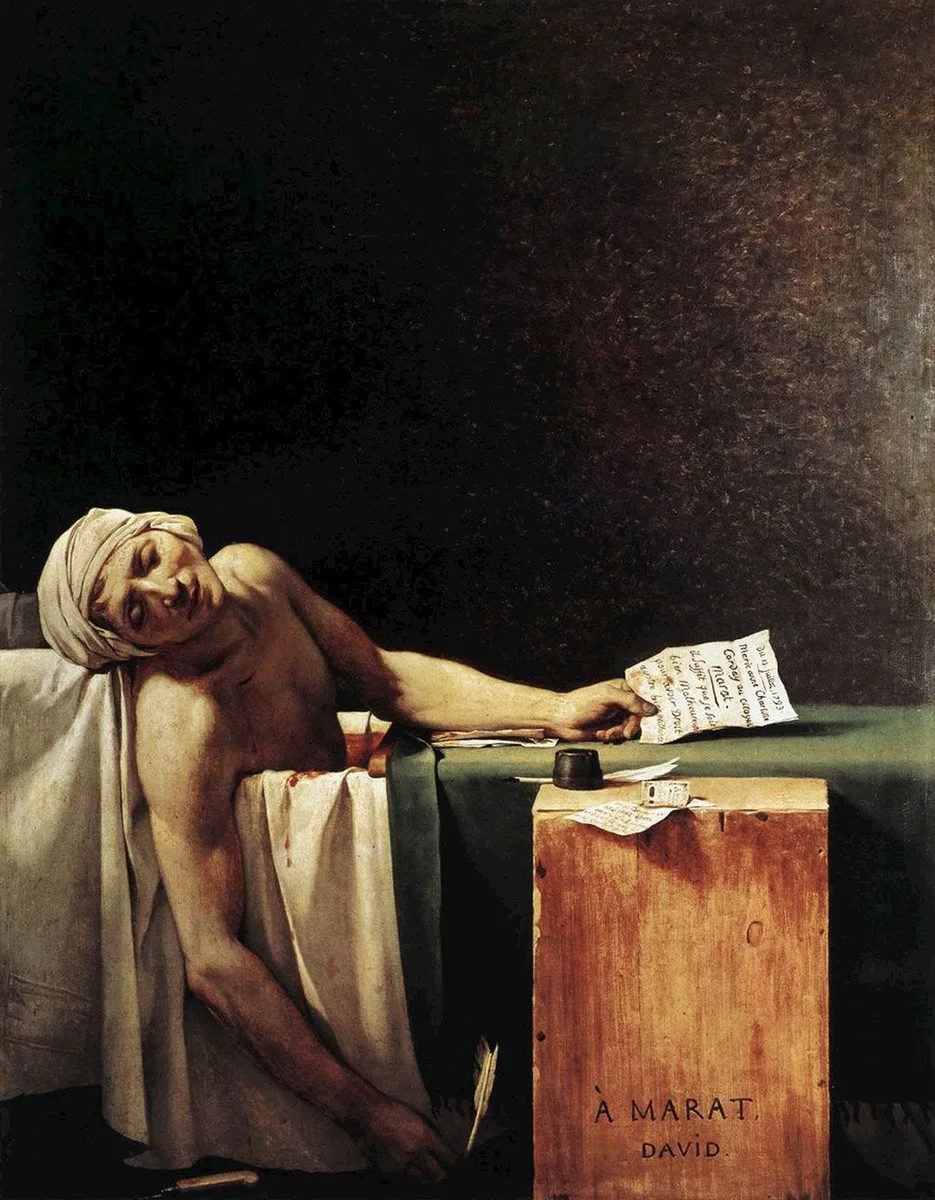
Corday’s memory was not shrouded in darkness as Sade had hoped. Yet although effigies of a beautiful Corday did proliferate in the wake of the killing in the most famous image of the murder of Marat she is conspicuous by her absence. Jean Louis David’s Death of Marat was completed in October 1793. Corday is only represented in the form of a ‘duplicitous letter’ which TJ Clark argues, ‘establishes truth and falsehood as what the picture mainly turns on.’ The manifest content of the letter is truthful but its latent content is falsehood. How, David’s painting asks, was Marat to have suspected Corday’s duplicity? Clark argues that the painting ‘enacts the contingency of claims to truth and falsehood at the moment it was made’. He contends that it does not embrace uncertainty but represents an anxious attempt to guard against it: ‘doubts [are] foisted on it by the very urgency of its effort to guarantee truth, to show it inhering in the world.’ For Clark, the painting attests to the ‘excess of reality’ – the painting’s obsession with establishing truth is borne of uncertainty about what truth is and where it resides. The slipperiness of truth – an uneasy relation between the verifiable and the indiscernible – can also be discerned in the ‘weird disparity in the painting between its insistence on matter and its treatment of where matter is not.’[ Despite the detailed depiction of an array of specific objects belonging to Marat, the upper half of the painting remains empty, an emptiness whose contrast with the cluttered scene below calls that reality into question. Clark insists that ‘the visual is a far weirder thing than language’ but I want to demonstrate that material artefacts are sometimes even weirder than that.
Following his assassination, Marat’s ‘sacred heart’ was removed from his chest and placed in a bejewelled urn at the centre of an altar in the Jardin de Luxembourg. David had initially proposed re-creating the moment of death with Marat’s embalmed body but this proved impossible due to the rapid deterioration of the corpse. A compromise was reached: the body was displayed in a former monastery covered in a chemical-infused sheet. Due to the rotting of the flesh, however, the arm holding the pen in the scene belonged to another person’s corpse. Staging the authentic, auratic presence of the revolutionary martyr thus relied on artifice. Similarly, the skull that appeared in Paris a century later, which was used as scientific evidence to make definitive claims about truths inhering in the world by Lombroso may not have been Corday’s at all.
According to some accounts, Corday’s remains were exhumed along with the corpse of Marie Antoinette in 1815 from the ditch into which they’d been tossed. However, it seems Corday’s severed head may not have been buried along with her body. Whoever first acquired the head is rumoured to have handed out Corday’s teeth as bribes to persuade people to keep their knowledge of the purchase secret. One anecdote refers to the head, preserved in alcohol with half-closed eyes, being proudly brought out during the dessert course of a dinner party by the man who had performed the autopsy. In 1840 the skull (now devoid of flesh) again made an appearance as a macabre dinner table decoration. The skull’s owner at the time of the 1889 Exposition was Prince Roland Bonaparte, the great-nephew of Napoleon, father of psychoanalyst Marie Bonaparte and President of the Society of Geography in Paris. In 1898 a Doctor Cabanès visited Bonaparte in an attempt to verify the authenticity of the skull. But Bonaparte, it turned out, had no evidence of the skull’s provenance so directed the curious doctor to the man from whom the skull had been purchased. The latter claimed to have stumbled upon the skull in the cupboard of a relative who had inherited from it someone else who had themselves purchased it from a dealer of curiosities. Detective-like Cabanès tracked down the sale in question but despite reading long, detailed lists of weird relic-commodities – including the moustache of Henri IV, a gold ring containing half of one of Voltaire’s teeth and a branch of the willow tree overshadowing Napoleon’s grave -– he could find no evidence in the catalogue of Corday’s skull. Cabanès thus concluded that the skull could have belonged to anyone, perhaps even to a man. Topinard’s and Lombroso’s discussions of the skull both proceeded from the assumption that it was Corday’s; their gendered conclusions about the skull’s essential properties therefore preceded their analyses. ‘Essence’ was derived not from the object itself then, but from pre-existing ideas about it.
In The 18th Brumaire of Louis Bonaparte Karl Marx depicts the 1848 revolution as a phony restaging of the revolution of 1789, which at least had the dignity to borrow its costumes and props from the more heroic, ancient past. For Marx, the 1851 coup of Louis Bonaparte appears as a farcical reenactment of the authentic tragedy of the coup of Napoleon Bonaparte (which happened on the real 18th Brumaire back when the revolutionary calendar still existed). Louis Bonaparte is thus presented as a crude caricature or counterfeit version of Napoleon Bonaparte. ‘The French, so long as they were engaged in revolution, could not get rid of the memory of Napoleon’, Marx says, and thus they remained haunted by their recent history. Marx also makes much of the coincidence of names between the two Bonapartes, which, he points out, did not necessarily imply any actual familial connection:
Historical tradition gave rise to the French peasants’ belief in the miracle that a man named Napoleon would bring all glory back to them. And there turned up an individual who claims to be that man because he bears the name Napoleon, in consequence of the Code Napoleon, which decrees: “Inquiry into paternity is forbidden.” After a twenty-year vagabondage and a series of grotesque adventures the legend is consummated, and the man becomes Emperor of the French.
For Marx then, the grotesquely mediocre Louis Bonaparte relied for legitimacy on the cult of Napoleon Bonaparte, which he compares to the veneration of a holy Catholic relic allegedly taken from the dying Christ: ‘The cult of the Holy Tunic of Trier he duplicates in Paris in the cult of the Napoleonic imperial mantle.’ This, Marx insists, was a flimsy basis upon which to build power and would therefore prove unsustainable.
Coming back to the example of the skull presumed to be Corday’s we find another Bonaparte in possession of an object whose authenticity was likewise uncertain. As in the case of Louis Bonaparte, the skull’s meaning was derived from an unverifiable claim about its origins. Corday’s skull was not venerated like Marat’s heart or the shroud of Trier but was nonetheless imbued with a significance that was said to inhere in it. And like the substitute arm used in the re-staging of Marat’s death scene or the objects sold as relics at auction, it didn’t matter whether it was really her skull or some other person’s as long as it was believed to be hers because, in fact, meaning was extrinsic to those objects, just as it was to Louis Bonaparte.
Making history
Clark’s analysis of ‘The Death of Marat’ discusses the various pieces of paper in the painting at length, and the different kinds of writing they display – the queasy way the contrast between Corday’s ‘duplicitous’ letter and Marat’s ‘truly benevolent’ letter inadvertently enact the slipperiness of the categories of duplicity and authenticity the painting seeks to overcome. There is also a third piece of paper in the painting to which Clark pays slightly less attention: an assignat. In Year 1 of the revolution, the French Constituent, or National, Assembly created a supposedly national paper money, the assignats notionally backed by nationalised land confiscated from the Catholic Church. Darius Spieth claims David’s painting contains ‘the first visual representation of paper money in Western art.’ The success or failure of the assignats, as with all forms of currency, depended on trust. Although these pieces of paper weren’t really pieces of land, they could ‘circulate as land’ as long as people accepted that they could. As Rebecca Spang writes in Stuff and Money in the Time of the French Revolution:
Much as a communion wafer was flour and water that, at a certain moment, became the body of Christ, so could the pulped and treated rag fibres that made up a piece of paper transubstantiate - when marked with the right insignia and consecrated by a correctly constituted authority - into ‘a piece of land whose fruits the bearer can harvest at will.’
In both cases – and in the case of the skull said to be Corday’s – meaning did not inhere in the object itself but was, to cite Spang again, a ‘product of humans’ interactions with objects and with each other.’
Lombroso’s analysis of Corday’s skull and scientific discussions of Meinhof’s brain circulated by the West German state and media were based on assumptions about gender and political violence. The dead body parts were used to confirm existing ideas about the nature of women, which influenced how that material was interpreted. For Third, however, the example of Meinhof’s brain demonstrates that in death the corpse resists. She claims that inert matter remains unyielding, non-compliant. Science, according to Third, requires the dead body ‘behave according to a pre-existing set of cultural-scientific assumptions’ but the corpse exceeds and even contradicts those assumptions. Meinhof’s brain, Third argues, refused to be contained by the taxonomies and meanings foisted upon it from without. Third thus reads the politically violent woman, even in death, as ‘a figure of excess [who] stubbornly resists such attempts at appropriation and understanding’, recalling Clark’s discussion of the ‘excess of reality’ in David’s painting.
But I’d be wary to grant so much agency to fragments of corpses. Dead matter is mute. It’s all very well for a bit of corpse to exceed the analysis of an onlooker but, as we have seen, matter can be ventriloquised very effectively and ideas about what stuff – flesh, bone, tree branches, gold, paper or whatever else – means can assume the status of truths that are remarkably tenacious and powerful. In the face of physical evidence to the contrary, for example, someone like John Locke could proclaim that gold is inherently valuable or someone like Lombroso could proclaim that women are inherently inferior to men or that black people are inherently inferior to white people. We can’t rely on lumps of gold or bits of bone alone to contradict those claims. It takes the living to intervene. And even that is easier said than done. After all, Topinard’s critique of Lombroso’s scientific methodologies did not immediately or automatically discredit phrenology.
Ghosts and sausages
In the introductory pages of Stuff and Money in the Time of the French Revolution Spang likens money to the category of gender as defined by Judith Butler: ‘not fixed or made once and for all but something that exists thanks only to its repeated enactment (not one interpellation but a whole series of them).’ Bodies are matter. The meanings we associate with that matter do not reside in those bodies alone, however, but are constantly produced and re-produced through reiterated social practices. In Butler’s canonical formulation: ‘as a sedimented effect of a reiterative or ritual practice, sex acquires its naturalised effect.’ Through a process of reiteration something historically produced comes to be mistaken for something natural, a priori and eternal; through various repeated social practices people’s roles in creating and sustaining the meanings attached to particular kinds of matter are forgotten. Living bodies also exceed the labels we affix to them – including the genders we assign to them – but although gender is performative it cannot be likened to a costume that can be removed or donned at will as it precedes individuals and is relational (not one interpellation but a whole series of them). Butler insists that gender ‘is certainly not a question of taking on a mask.’ Third still imagines truth inhering in the world beneath a pile (or mask) of obfuscating categories, whereas Butler discerns that those categories participate in making the world and the people in it, however ‘untrue’ those categories may be. But although acknowledging that something was and continues to be made does not automatically unmake it, it does at least imply that it is re-makeable. Analysing the ‘mystical character’ of the commodity form does not automatically overthrow capitalism but Marx still thought it was a good place to start.
In The 18th Brumaire of Louis Bonaparte, as in David’s painting, the relationship between authenticity and artifice is uneasy. But in spite of his elaborate metaphors of masquerade and haunting, derisive remarks about Louis Bonaparte’s pathetic parodying of history, disdain for the lumpen proletariat and scorn at their enticement by some ‘cold poultry and garlic sausage’, Marx is grudgingly forced to concede that however mediocre, theatrical and ridiculous-seeming this was really history – full of ghosts and sausages. The 18th Brumaire does grant agency to the dead but in a different way to Third’s analysis of Meinhof’s brain which dispenses with misogyny but clings onto a form of essentialism by insisting that the bodies of women who commit acts of political violence have inherent properties. Marx is not interested in physical corpses but in memories, traditions, customs and sedimented practices, which ‘weigh like a nightmare on the brains of the living.’ The tradition of ‘all the dead generations’ might sound like historical immaterialism but Marx acknowledges their reality and weight; for people – let’s not say ‘men’ – to (re)make their own history those heavy ghosts must be confronted and exorcised.