22 April 2024
The Nuclear Unconscious
it is not pathological to hope for a better future – for instance, for peace – and to strive for it, while recognizing how hard it is to attain
Hanna Segal
Two essays I wrote recently were both published last week. Though different in emphasis they both discuss the psychological implications of the atomic bomb: as past reality and future possibility.
The first is a review essay of two recent books on the history and pre-history of PTSD: Combat Trauma by Nadia Abu El-Haj and Nuclear Minds by Ran Zwigenberg. I happened to read these books in quick succession and was struck that they both accorded a prominent role to the American psychiatrist Robert Jay Lifton albeit in very different ways: Combat Trauma discusses his clinical work with antiwar veterans of the American war in Vietnam, while Nuclear Minds considers his earlier book Death in Life: Survivors of Hiroshima. I didn’t want to make this a story all about one guy - particularly as Nuclear Minds de-centres Lifton to explore earlier social scientific studies of survivors of Hiroshima and Nagasaki - but the political argument that Nadia Abu El-Haj makes via Lifton’s work seemed important.
Also published last week was an academic article for the journal Psychoanalysis and History on the British Kleinian psychoanalyst Hanna Segal, ‘Splitting Atomic Minds: Hanna Segal and the Fear of Nuclear War in 1980s Britain’. Lifton’s research in Hiroshima examined the psychological effects of the atomic bomb on people who had survived the blast, whereas Segal wrote about anxieties about the possibility of a future nuclear war. Her patients in London brought up their fears of nuclear war on the couch and she also published essays articulating her opposition to nuclear weapons in the same period. I argue that though her work arose from its specific context in 1980s Britain, her arguments about the relationships between politics and the psyche are of broader interest.

*
Masha Gessen recently interviewed Lifton in The New Yorker.
Nadia Abu El-Haj’s recent lecture ‘The Impossible Genocidaire: Gaza, the Jewish State, and the Shadow of Auschwitz’ delivered at Swarthmore in March 2024 is available to watch online (as part of a series of lectures that all look interesting).
Hanna Segal’s Desert Island Discs is also amazing (though Sue Lawley’s interview style is quite jarring and abrasive). Segal tells an anecdote about her parents catching her as she was trying to run off to fight in the Spanish Civil War in such a moving way that it made me cry while I was listening to this on the bus.
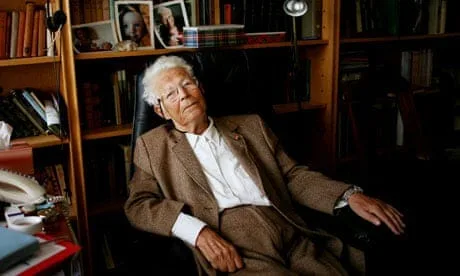
Also feel compelled to say that Hanna Segal smoked a pipe and dressed in very inspirational suits, for example:
*
My book came out just under two weeks ago and I’m trying to keep track of Burnout interviews and reviews and things here. Speaking about my work is all a bit weird and new and I’m not very good at talking spontaneously in coherent sentences. But I’m finding it so interesting to talk about the themes of the book with people and feel very grateful that I have got to hear about other people’s associations and experiences.
I’m doing a talk in New York at the n + 1 offices - 37 Greenpoint Ave #316 - on May 1st with Tess Edmonson. Hopefully will do a couple more USA things in May too (tbc)!
*
Last week I did a short reading as part of a performance by the artist Shona Macnaughton at the University of Glasgow. The event was taking place on the same evening as a demonstration at the university in solidarity with Dr Ghassan Abu-Sittah.
This is how I ended my talk (Barnaby Raine previously quoted the Reid text in a tweet, - you can read the text in full here):
On March 26th Dr. Ghassan Abu-Sittah was elected by the students of Glasgow University to serve as rector in a landslide. Right now an emergency protest is taking place in solidarity with him after he was barred from entering Germany to address the Palestinian Congress. He has worked as a medic in Gaza for over 25 years. In his address he referenced a previous rector of the university, Arthur Balfour whose ‘46-word declaration announced the British government’s support for the settler colonisation of Palestine.’ Abu-Sittah came to study medicine in Glasgow in 1988. Of that time he recalled:
it was in Glasgow that I saw for the first time the meaning of international solidarity. Glasgow in that time was rife with groups that were organising solidarity with El Salvador, Nicaragua and Palestine.
Jimmy Reid, Communist, trade unionist and former Clyde shipbuilder was elected rector of the university in the early 1970s. In his address he wrote:
Society and its prevailing sense of values leads to… alienation. It alienates some from humanity. It partially dehumanises some people, makes them insensitive, ruthless in their handling of fellow human beings, self-centred and grasping. The irony is, they are often considered normal and well adjusted. It is my sincere contention that anyone who can be adjusted to our society is in greater need of psychiatric analysis and treatment than anyone else…
These words seem to speak to the present.
In my book, Burnout: The Emotional Experience of Political Defeat, I talk about historical attempts to develop forms of ‘anti-adaptive healing’. This is an understanding of healing that does not accept the wounded and wounding qualities of society as it is currently structured. Anti-adaptive healing would be a form of healing that does not equate getting better with adjustment to or acceptance of existing social conditions. Reid’s speech, like many radical texts from the late 1960s and early 1970s, makes clear that adjustment to a violent and oppressive social reality should not be equated with ‘health’ or ‘sanity’.
Abu-Sittah discusses his work as a medic as part of the struggle for Palestinian liberation. Caring for people’s bodies and minds cannot be thought of in isolation from broader social and political struggles. He quotes Brecht asking: "Whose tomorrow is tomorrow? And whose world is the world?"
I’ll end by quoting Reid again:
Reject the insidious pressures in society that would blunt your critical faculties to all that is happening around you, that would caution silence in the face of injustice lest you jeopardise your chances of promotion and self-advancement… The price is too high. It entails the loss of your dignity and human spirit.
Free Palestine.
*